
The winter season gives farmers something no other season offers: time. Time to interpret data, plan strategically, and prepare intelligently.
This is why winter soil management is far more than an off-season task. It lays the groundwork for improved nutrient use efficiency, better seedbed conditions, and smoother planting when spring finally arrives.
For many growers, winter soil preparation is a chance to step back, understand what worked and what didn’t, and adjust with clarity instead of pressure. Preparing soil for spring planting starts long before the tractor rolls out of the shed.
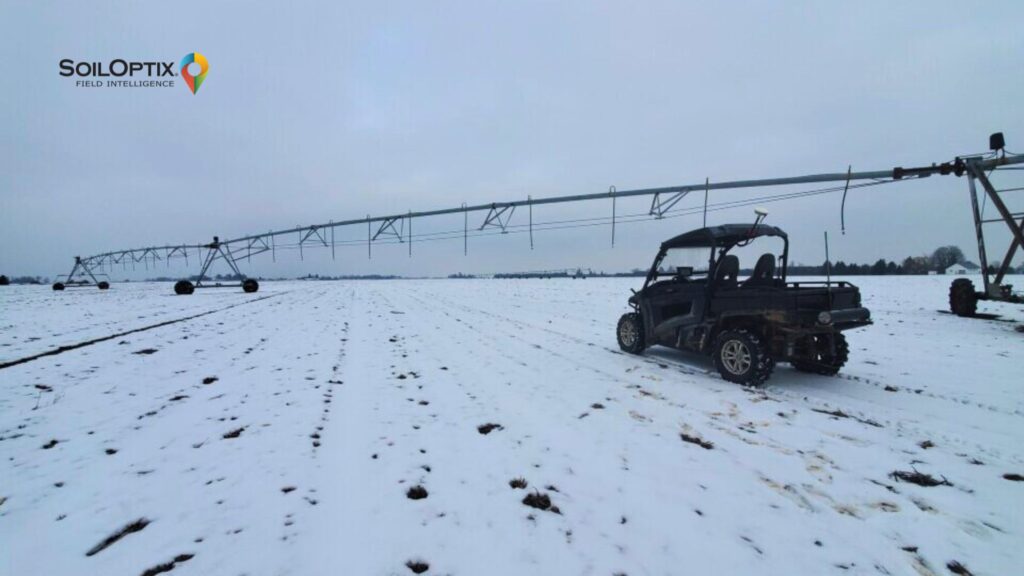
SoilOptix® technology enables precise surveying even in light snow (up to 4 inches), through crop residue, and on frozen ground—helping you extend your surveying season and maximize year-round productivity.
This comprehensive guide explores the key off-season soil care tasks that support healthier soils, stronger spring emergence, and more consistent yields.
Why Winter Soil Management Matters
Though fields lie dormant, soil processes never stop. The microbial activity slows but continues cycling nutrients.
With that in mind, farmers are better equipped to:
- Anticipate nutrient needs
- Recognize compaction risks
- Plan precise field operations
- Improve water management
- Avoid last-minute surprises in spring
Managing soil in winter provides breathing room to evaluate decisions calmly—something spring rarely allows.
1. Analyze Soil Test Results and Build Strategic Nutrient Plans
Winter is the perfect time to step back and analyze soil test results without the distractions of fieldwork.
This is the season to compare year-over-year nutrient trends, identify deficiencies, evaluate pH changes, and consider how upcoming crop rotations affect fertilizer decisions.
Farmers can use soil testing fundamentals outlined in USDA’s long-term soil management references. With no urgent timeline, farmers often develop more cost-effective fertilizer plans when they have time to analyze data properly.
And for operations using high-resolution soil mapping systems like SoilOptix®, winter is when growers often revisit their maps to understand variability and plan more targeted input applications for spring.
2. Evaluate Soil Structure and Compaction Issues
Soil compaction reveals itself most clearly after harvest.
Winter is an ideal time to:
- Review yield maps for consistent low-performing zones
- Identify headlands or traffic corridors that may need attention
- Consider whether spring vertical tillage or strip-till may be necessary
- Plan traffic lanes for the upcoming season
Taking time to diagnose compaction in winter reduces guesswork and helps farmers avoid making reactionary decisions in spring when soil conditions can be more fragile.
3. Residue Management and Winter Decomposition
Crop residue plays a major role in supporting long-term soil health. It protects the surface, reduces erosion, contributes to organic matter, and influences moisture retention. But residue must be evenly distributed to support a uniform seedbed.
Winter allows growers to evaluate:
- Uneven residue spread behind combines
- Thick mats that could delay soil warming
- Areas where corn stalks remain upright and slow decomposition
- Differences in residue breakdown between high and low organic matter zones
Manitoba Agriculture provides stable, long-standing resources on residue and winter decomposition.
Understanding residue behaviour over winter helps farmers determine whether light spring residue management is required or whether natural decomposition is sufficient.
This article highlights the significance of crop residue and the top factors affecting its levels.
4. Plan Cover Crop Termination Strategies
Winter cover crops are increasingly part of modern farming systems, contributing to improved soil health, nutrient retention, and erosion control. But their benefits are maximized only when termination is properly timed.
Winter is the time to finalize:
- Termination method (chemical, mechanical, or integrated)
- Ideal timing relative to expected planting dates
- How termination will affect soil moisture and temperature
- Whether cover crops should be rolled, crimped, or sprayed
NDSU provides an excellent stable hub for cover crop management principles.
By planning termination early, growers avoid being forced into rushed decisions right when spring conditions become favourable.
5. Use Winter for Reviewing Mapping Layers and Field Variability
One of the most valuable winter tasks is analyzing field maps—soil texture layers, organic matter variability, pH distribution, topography, elevation, moisture patterns, and yield maps.
Mapping reveals how the field behaved during the previous season and guides smarter decisions about spring fieldwork.
Winter is the season for connecting the dots:
- Why did certain zones yield less?
- Do those zones correlate with soil texture?
- Did nutrients run short in specific areas?
- Should certain fields be prioritized for spring sampling?
These insights become the backbone of precise and efficient spring operations.
6. Assess Drainage, Water Flow, and Erosion Patterns
Drainage issues are often more visible in winter than in summer. Snowmelt, freeze cycles, and winter rains expose pooling areas, slow-draining depressions, or new erosion channels formed during fall storms.
Taking time in winter to evaluate these issues allows for:
- Tile drainage repairs or expansions
- Spot grading or leveling
- Waterway maintenance
- Strategic shaping to control overland flow
Understanding how water moves across the landscape during winter ensures better field access during spring.
7. Evaluate Soil Health Indicators
Winter gives growers time to evaluate how well their soil health strategies are working. This includes reviewing trends in:
- Organic matter
- Soil structure and aggregation
- Biological activity
- Moisture retention
- Root penetration depth
Evaluating these indicators during winter supports long-term resilience, especially in fields prone to drought stress or inconsistent yield performance.
8. Plan Crop Rotations with Soil in Mind
Winter is a valuable season for reviewing crop rotation strategies. Rotation influences nutrient cycling, disease pressure, soil organic matter, and water use patterns.
A globally stable resource for crop rotation concepts is the FAO’s rotation principles PDF.
Reviewing rotations now ensures fields are positioned for better fertility balance and improved soil structure in the coming years.
9. Map Out Spring Field Priorities
Finally, winter gives growers the chance to plan an orderly, thoughtful sequence of spring operations, which will reduce stress and optimize labour and equipment use, by identifying:
- Which fields typically dry first
- Which areas might need residue work
- Where fertilizer or amendments should be applied early
- Which fields require sampling before planting
Planning now ensures spring fieldwork unfolds smoothly—even when weather throws challenges into the mix.
Conclusion: Winter Planning for Spring Success
Winter is far more than a dormant season—it’s a strategic season.
From analyzing soil tests and evaluating compaction to planning rotations and reviewing maps, growers who invest in winter soil management set the stage for healthier soils, stronger early growth, and more consistent yields.
Winter is also the ideal time to prepare farm equipment and digital tools.
Farmers who perform these tasks during winter experience fewer delays and avoid costly downtime when weather windows open in spring.
Thoughtful winter soil preparation for farmers is one of the most influential steps in ensuring spring success.
By using winter to begin preparing soil for spring planting, growers enter the new season confident, organized, and ready to seize every weather window available.
Book your SoilOptix® scan today and take the next step toward unlocking your soil’s full potential.
Contact Us to Get Started