
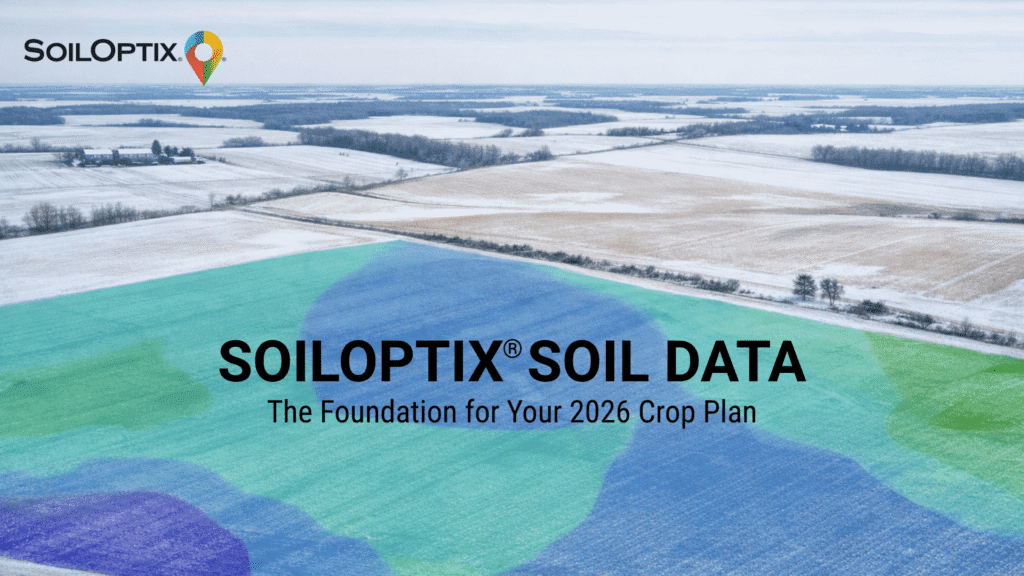
With fertilizer costs rising and margins tightening, growers can’t afford guesswork in 2026, and planning for a successful season starts long before the first field passes in spring.
The most resilient and profitable farms are those that build their crop plans on a strong understanding of soil variability, fertility, and productivity potential. High-resolution soil mapping provides the foundational data growers need to make smarter fertilizer, seeding, and management decisions.
With SoilOptix® soil data captured even in winter conditions, growers can get ahead of the season and enter spring with confidence.
Effective soil data crop planning starts with understanding how soil variability influences every input decision across the field. By evaluating high-resolution soil maps before spring, growers can align fertilizer strategies, seeding prescriptions, and management zones with actual soil conditions rather than field averages. This approach supports more confident decision-making and sets a strong foundation for the 2026 growing season.
What High-Resolution Soil Mapping Means for 2026 Crop Planning
High-resolution soil mapping gives growers a detailed, accurate understanding of the variability that exists across every acre.
Unlike conventional soil sampling methods that rely on broad averages or wide grid spacing, SoilOptix® uses advanced gamma-ray sensing technology to collect 335 data points per acre, producing some of the industry’s most detailed soil maps.
These maps identify subtle but significant differences in texture, organic matter, nutrient distribution, pH, and other soil properties that directly influence management decisions.
As input costs continue to fluctuate and margins tighten across agriculture, understanding this variability is critical for any 2026 crop plan.
How Soil Mapping Drives Smarter Decisions This Season
- More precise variable rate nutrient applications
- Stronger, data-driven seeding strategies
- Clear management for VRA decisions
- Higher return on fertilizer and seed investments
- Better yield stability across variable fields
Winter Soil Mapping Advantage with SoilOptix®
A key benefit of SoilOptix® is its ability to collect soil data on bare frozen ground or in up to four inches of light, fluffy snow. Heavy crusted snow is not recommended, but winter provides an excellent opportunity to map fields without disturbing in-season operations. This allows growers to complete their soil analysis months ahead of spring and start planning early.
Essential Soil Health Indicators to Evaluate This Winter
Winter is the ideal time to step back and assess the soil health indicators that will guide your crop planning decisions.
SoilOptix® offers over 25 individual soil property layers, including physical properties, macronutrients, micronutrients, and complex models needed to understand each field’s productivity potential.
Here are the top indicators growers should evaluate this winter:
Organic Matter
Organic matter influences nutrient cycling, water-holding capacity, microbial activity, and resilience during drought or stress. High-resolution mapping shows where organic matter varies, helping guide management decisions for population and fertilizer.
Cation Exchange Capacity (CEC)
CEC reflects the soil’s ability to hold and exchange nutrients. Fields with low CEC require more precise nutrient management to avoid leaching and loss, while higher CEC areas may benefit from different fertility strategies.
Soil Texture
Texture impacts water infiltration, nutrient retention, and seeding depth recommendations. Understanding sand, silt, and clay distribution helps refine decisions about tillage, seeding, and hybrid placement.
pH Variability
pH strongly influences nutrient availability. Layered pH maps help identify where lime applications will generate the greatest value and prevent nutrient lockout.
Nutrient Distribution
High-resolution nutrient maps for P, K, Ca, Mg, and micros give growers a complete picture for developing advanced fertility plans and variable-rate applications.
Bulk Density & Compaction Indicators
Identifying compacted or high bulk-density areas early guides spring field operations and helps protect emergence and root development.
Salinity (where relevant)
Certain regions or low-lying fields may require detailed salinity mapping to prevent crop stress and yield loss.
For additional seasonal management tips, growers can explore the SoilOptix® Winter Soil Management Guide.
How SoilOptix® Data Optimizes Fertilizer Rates and Seeding Prescriptions
The real power of SoilOptix® soil data is how it transforms crop planning decisions. By combining high-density soil maps with agronomic insights, growers gain the precision needed to optimize both fertilizer investments and seeding decisions for the 2026 season.
Using precision agriculture soil data allows growers to move beyond uniform input strategies and manage fields based on real soil variability. High-resolution soil mapping provides the detail needed to fine-tune fertilizer rates, adjust seeding populations, and reduce risk across different soil zones. This level of insight helps improve input efficiency while supporting more consistent crop performance.
Smarter Variable-Rate Fertilizer Applications
Understanding nutrient distribution and soil texture variability allows growers to:
- Avoid over-applying fertilizer in areas with lower yield potential
- Correct deficiencies where fertility is limiting productivity
- Allocate inputs more efficiently during a high-cost environment
- Increase fertilizer-use efficiency and reduce waste
With SoilOptix®, fertilizer decisions transition from broad assumptions to precise, VRA-based strategies backed by real soil data.
Research from the Iowa State University Extension on precision agriculture and variable-rate guidelines supports the use of data-driven fertilizer and seeding strategies to improve nutrient efficiency and reduce input waste
Optimized Seeding Recommendations
High-resolution soil mapping enhances seeding prescriptions by:
- Matching seeding populations to the soil’s ability to support yield
- Reducing risk in low organic matter or shallow topsoil areas
- Maximizing return in high-potential
- field areas
- Protecting emergence with better soil texture and moisture insights
Instead of uniform planting, growers can tailor their approach to variability across the field and improve overall yield consistency.
Multi-Year Value
SoilOptix® maps serve as a long-term planning asset. Growers can:
- Compare results year-over-year
- Enhance rotation planning
- Build multi-season fertility strategies
- Continually refine prescriptions
Case Study: Comparing SoilOptix® to Other Mapping Technologies
Independent comparison studies have demonstrated the advantage of SoilOptix® over conventional soil mapping tools. The Technology Comparison Study showcases how SoilOptix® delivers superior resolution, accuracy, and map clarity compared to other systems.
Key Findings from the Study:
- SoilOptix® mapping produced more detailed nutrient and texture layers
- Higher correlation to lab sample results
- Better-defined management zones for VRA decision-making
- Stronger support for variable-rate fertilizer and seeding strategy development
This evidence helps growers understand why high-resolution soil mapping is becoming a new standard for precision agriculture and why SoilOptix® stands out.
Implications for 2026 Planning
With fertilizer price volatility and tightening profit margins, choosing a mapping system that delivers the most accurate data can significantly impact ROI. SoilOptix® gives growers the actionable clarity they need to make confident decisions for the upcoming season.
Actionable Steps for Growers Preparing for Spring 2026
As winter continues, growers can take the following steps to get ahead of the 2026 cropping season:
- Book a SoilOptix® scan early to secure winter scheduling and take advantage of frozen ground conditions.
- Review soil maps with your agronomist to identify pockets of opportunity and build prescriptions.
- Create variable-rate fertilizer and seeding plans tailored to soil variability.
- Refine crop rotation decisions using multi-layer soil data for long-term strategy.
- Use soil health indicators to guide input budgeting, reducing costs while improving efficiency.
- Leverage high-resolution data to improve yield stability and overall field performance.
With SoilOptix®, growers can enter spring with a detailed understanding of their soil’s strengths, limitations, and opportunities—making 2026 a season built on data, precision, and confidence.
If SoilOptix® mapping is part of your 2026 crop planning strategy, winter is the time to act.
Did you know that SoilOptix® can scan on frozen ground with no interference from crop residue and in up to 4 inches (10 cm) of light snow?
Book your SoilOptix® scan now to have high-resolution soil data ready for fertilizer planning, seeding prescriptions, and input decisions before spring. Winter scanning windows are limited, and having your data in hand early ensures you are making informed, confident decisions when it matters most.