
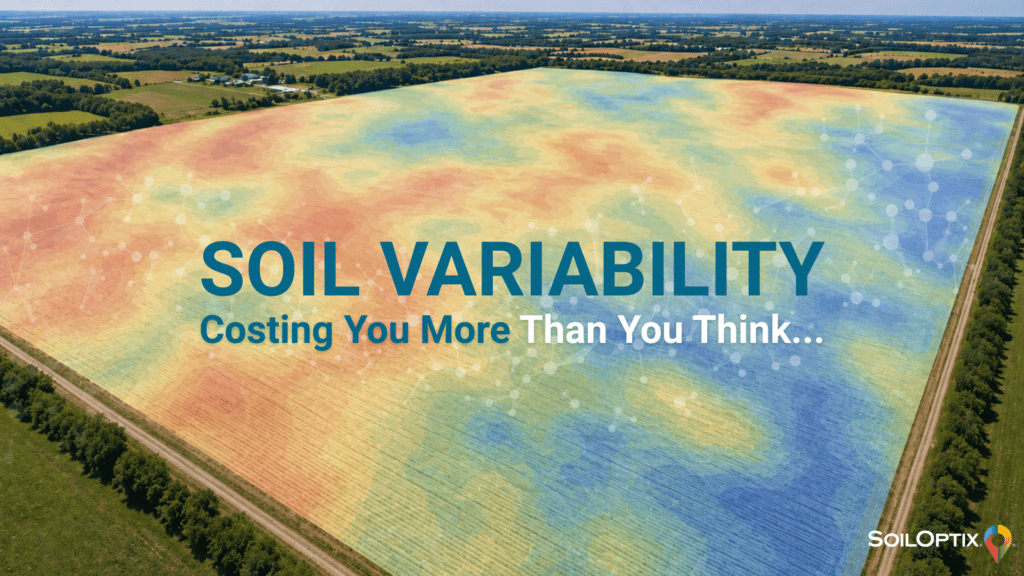
Every field tells a different story, yet too often, it is managed as if it were uniform.
Beneath the surface, soil properties can change dramatically within just a few feet. Nutrient levels, pH, organic matter, and texture all vary across a field, creating areas of both opportunity and limitation. When these differences are overlooked, the result is inefficient input use, inconsistent crop performance, and ultimately lost profitability.
The challenge is not soil variability itself. It is the inability to see it clearly and act on it effectively, limiting true soil data ROI.

The Hidden Reality of Soil Variability
Soil variability exists in every field. Even fields that appear visually consistent can contain significant differences below the surface.
These variations influence:
- Nutrient availability
- Water holding capacity
- Root development conditions
Research has consistently shown that soil properties can vary significantly within the same field due to factors like management practices, weather, and landscape position, reinforcing the need for more detailed insight.
Traditional management approaches often rely on averages. Whether through grid or zone sampling, the field is simplified into generalized areas. While this approach provides some insight, it fails to capture the full complexity of the soil.
As a result, decisions are made based on incomplete information, leaving critical variability unaccounted for.
Where the Costs Add Up
Ignoring soil variability does not just impact agronomic performance. It has a direct and measurable financial cost.
Over-Application of Inputs
When fertilizer is applied uniformly, areas with sufficient nutrient levels receive more than they need, leading to unnecessary input costs.
Under-Application in High-Need Areas
At the same time, areas that require more nutrients are under-served. These zones fail to reach their full yield potential, creating lost revenue that often goes unnoticed.
Inefficient Seeding Decisions
Uniform seeding rates assume uniform soil potential. In reality, some areas of a field can support higher plant populations, while others cannot. Without accounting for variability, crop performance becomes inconsistent.
Long-Term Soil Health Impact
Over time, mismanagement of nutrients leads to imbalances in the soil. Some areas accumulate excess nutrients, while others are depleted. This not only affects current yields but also impacts long-term soil productivity.

Why Traditional Soil Sampling Misses the Full Picture
Conventional soil sampling methods, such as grid and zone sampling, provide only a limited snapshot of the field, creating gaps in the data. Important transitions between soil types or nutrient levels are often missed, and smaller pockets of variability (or pockets of opportunity) go undetected.
In contrast, understanding soil variability requires a much higher level of detail, one that reflects the continuous nature of the field rather than isolated points.

What High-Resolution Soil Mapping Reveals
High-resolution soil mapping changes the way variability is understood.
Instead of relying on scattered data points, it provides a continuous view of the field, capturing subtle changes that traditional methods cannot detect.
With this level of detail, growers can identify:
- Micro-zones within fields
- Gradual transitions in soil properties
- Hidden patterns that influence crop performance
This deeper understanding allows for more precise and informed decision-making.
For a closer look at how this compares to traditional approaches, see the SoilOptix® technology comparison study.

Turning Soil Variability Into Better Decisions
Once variability is clearly defined, it becomes a powerful tool rather than a challenge.
Precision Fertilizer Application
This level of precision enables effective variable rate application, ensuring inputs are applied only where they are needed.
Variable Rate Seeding
Seeding rates can be adjusted based on soil potential, improving crop uniformity and maximizing yield in high-performing areas. For a deeper look at variable rate seeding driven by plant available water, explore our case study.
Improved Return on Investment
By aligning inputs with actual field conditions, growers can reduce unnecessary costs while increasing productivity.
Sustainable Farming Practices
More precise nutrient management reduces the risk of runoff and environmental impact, supporting long-term sustainability goals.

Real-World Impact: From Data to Profit
The difference between assumption-based and data-driven management is significant.
Without detailed soil data, decisions are based on averages and generalizations. With high-resolution insights, every part of the field can be managed according to its true potential.
Growers using this approach consistently see:
- More efficient use of inputs
- Greater yield consistency across fields
- Stronger overall profitability
Soil variability does not disappear. But with the right data, it can be managed in a way that drives measurable results.

Stop Letting Variability Work Against You
Soil variability is not the problem. It is a natural characteristic of every field.
The real issue is managing fields without fully understanding that variability.
By uncovering what is happening beneath the surface, growers can move from reactive decisions to proactive strategies. The result is better input efficiency, improved yields, and stronger long-term soil health.
With the right insights, variability stops being a hidden cost and becomes a competitive advantage.
If you’re ready to better understand the variability in your fields and turn it into a measurable advantage, contact us to learn how SoilOptix® can support your operation.