
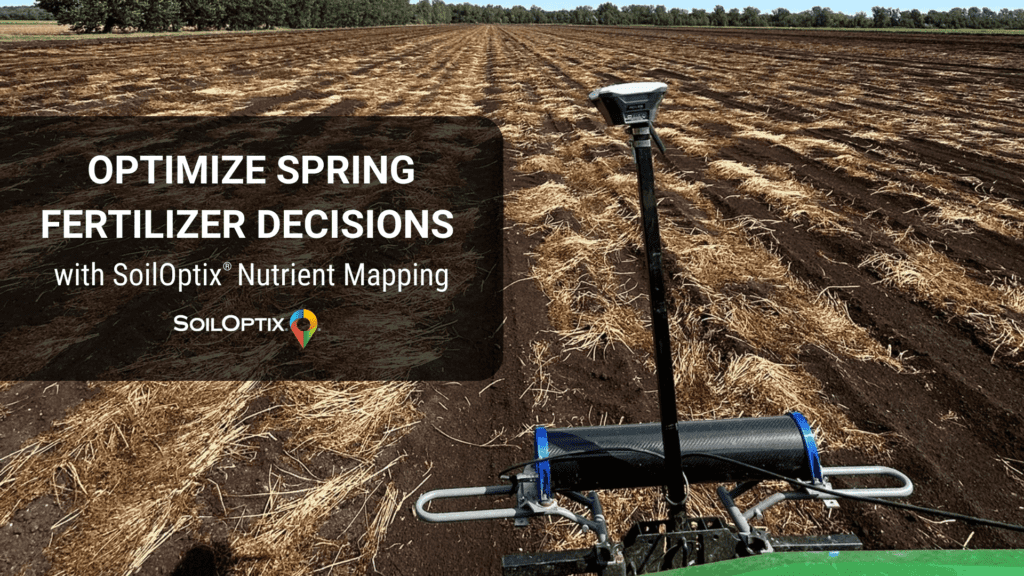
Is pre-plant fertilizer planning part of your early-season strategy? With rising fertilizer prices climbing and global input markets remaining volatile, pressure on farm profitability continues to intensify as the growing season approaches.
Fertilizer remains one of the largest and least flexible operating costs for many farms. Applying nutrients at the wrong rate or in the wrong areas can quickly erode margins. As a result, pre-plant fertilizer planning has become a critical decision point rather than a routine agronomic task.
In this environment, using high-resolution soil data to guide fertilizer strategies is no longer optional; it is a practical way to protect margins while improving fertilizer efficiency before planting begins.
The Challenge of Fertilizer Efficiency in 2026
While fertilizer efficiency has always played a critical role, its importance is escalating in today’s environment.
Input costs remain elevated, regulatory expectations continue to evolve, and growers are being asked to produce more with fewer resources. At the same time, most fields contain significant variability in soil fertility, texture, and nutrient availability.
Traditional soil testing methods, such as composite or low-density grid sampling, often struggle to capture this variability. While they provide useful baseline information, they can mask important differences within a field. This can lead to over-application in areas that do not require additional nutrients and under-application where crops need more support.
These inefficiencies increase costs and raise the risk of nutrient loss. Improving fertilizer efficiency now requires a clearer understanding of how soil properties change across every field before fertilizer plans are finalized.
SoilOptix® Nutrient Mapping Explained
High-resolution soil nutrient mapping provides a detailed view of soil properties and nutrient-related variability across an entire field. Rather than relying on field averages, this approach captures continuous data that reflects real spatial differences in soil conditions.
SoilOptix® uses a passive gamma radiation-based sensor to scan and collect high-resolution soil data across fields—335 data points per acre (827 per hectare), to be exact. This data supports soil fertility analysis by identifying patterns that are often missed by traditional sampling alone. The result is a clearer foundation for fertilizer planning decisions made ahead of spring planting.
By integrating high-resolution nutrient mapping into spring crop planning, agronomists gain the insights needed to design fertilizer strategies that reflect field conditions without making assumptions.
For a detailed overview of how the technology works from start to finish, including data collection and interpretation, a case study of SoilOptix® explains the full process.
How Data-Driven Fertilizer Plans Save Money and Boost Yields
Accurate soil data changes how fertilizer decisions are made. Instead of applying nutrients based on averages, growers can align rates with the true needs of different areas within a field.
This shift enables data-driven fertilizer decisions that directly support both cost control and crop performance.
When fertilizer rates are aligned with real soil variability, several practical benefits emerge:
- Reduced over-application in nutrient-sufficient zones
- Improved nutrient availability in under-supplied areas
- Better alignment between soil supply and crop demand
- More efficient use of fertilizer budgets
These insights give agronomists the confidence to move from estimates to true data-driven fertilizer decisions that support consistent crop yield optimization.
In many cases, farms can reduce fertilizer expenses without sacrificing yield, though in some situations it also identifies areas where additional nutrients are required.
See our Optimizing—Not Saving case study below.
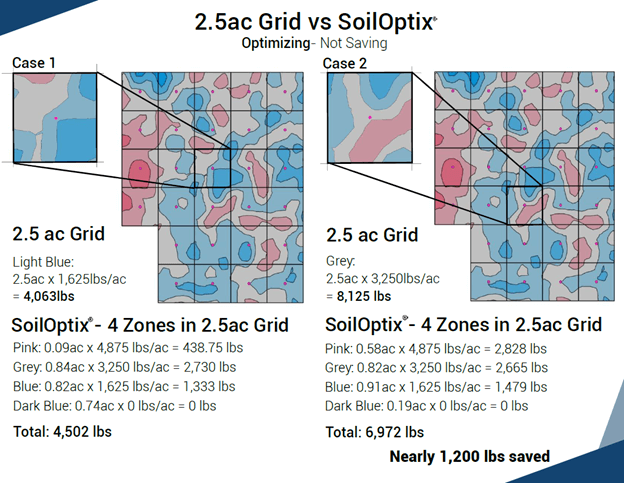
University extension research consistently shows that variable-rate fertilizer strategies, when supported by reliable soil data, improve nutrient use efficiency and reduce wasted inputs. This combination of agronomic and economic benefits makes soil data a valuable tool for fertilizer management in high-cost input environments.
Sustainability Benefits of Smarter Fertilizer Use
Beyond economics, soil nutrient mapping plays an important role in environmental stewardship. Applying fertilizer where it is needed and avoiding excess where it does not help limit nutrient movement beyond the root zone.
One of the most significant benefits is runoff reduction.
Excess nutrients applied to already sufficient soils are more likely to move into waterways through surface runoff or leaching. Soil nutrient mapping spring planting strategies help ensure nutrients remain available to crops rather than leaving the field.
Smarter nutrient placement supports sustainable fertilizer use while helping farms meet environmental expectations. Agricultural research organizations and international agencies consistently highlight targeted nutrient management as a key strategy for protecting water quality and improving long-term soil health.
As sustainability reporting and environmental accountability continue to expand, fertilizer programs grounded in accurate soil data will become increasingly important.
Why Pre-Plant Soil Analysis Is the Smartest Investment
Spring fertilizer decisions set the tone for the entire growing season. That is why pre-plant fertilizer planning supported by accurate soil data is one of the most valuable investments a farm can make heading into spring.
Soil nutrient mapping provides the clarity needed to:
- Allocate fertilizer budgets more efficiently
- Support consistent crop performance across variable fields
- Improve confidence in agronomic recommendations
- Align profitability goals with sustainability objectives
Using soil nutrient mapping for spring planting allows growers and agronomists to enter the season with a clear, defensible plan based on real field data. Optimizing fertilizer decisions is not about applying more. It is about applying smarter, earlier, and with greater confidence.
As fertilizer prices remain high and margins stay tight, the difference between average and optimized decisions can define the season. Now is the time to strengthen your pre plant fertilizer planning with accurate soil data and practical insights.
If you are looking to make more confident data-driven fertilizer decisions this spring, connect with the SoilOptix® team to learn how nutrient mapping can support your crop planning strategy.