
Fertilization and soil health management are not “one-size-fits-all” decisions. Yet across millions of acres, nutrient strategies are still built on field averages. Soil variability rarely behaves in averages. Nutrient availability, plant-available water, cation balance, and soil texture can shift dramatically within short distances. When precision fertilization strategies rely on limited sampling zones, growers risk overapplying nutrients in some areas and underfeeding others.
High-resolution soil mapping changes that equation. By measuring variability at scale and integrating georeferenced sampling data, SoilOptix® enables stronger fertilizer variability mapping and more confident agronomic decisions. The result is improved variable rate performance, strengthened soil stewardship, and measurable soil data ROI.
The following SoilOptix® case studies demonstrate how real growers are using high-resolution soil intelligence to build smarter precision fertilization strategies and generate measurable returns.
High‑Resolution Soil Data: The Missing Link in Truly Effective Precision Fertilization
Conventional grid or zone sampling has advanced nutrient management significantly. However, lower sampling density can smooth over micro-variability that directly influences crop response. Broad management zones often assume uniformity where meaningful variability exists.
This limits the effectiveness of precision fertilization strategies and creates three common risks:
• Overapplication in nutrient-sufficient areas
• Underapplication in deficient zones
• Reduced fertilizer efficiency
The comparison below shows how broad management zones can overlook key variability, and how those missed opportunities can ultimately shape management decisions.
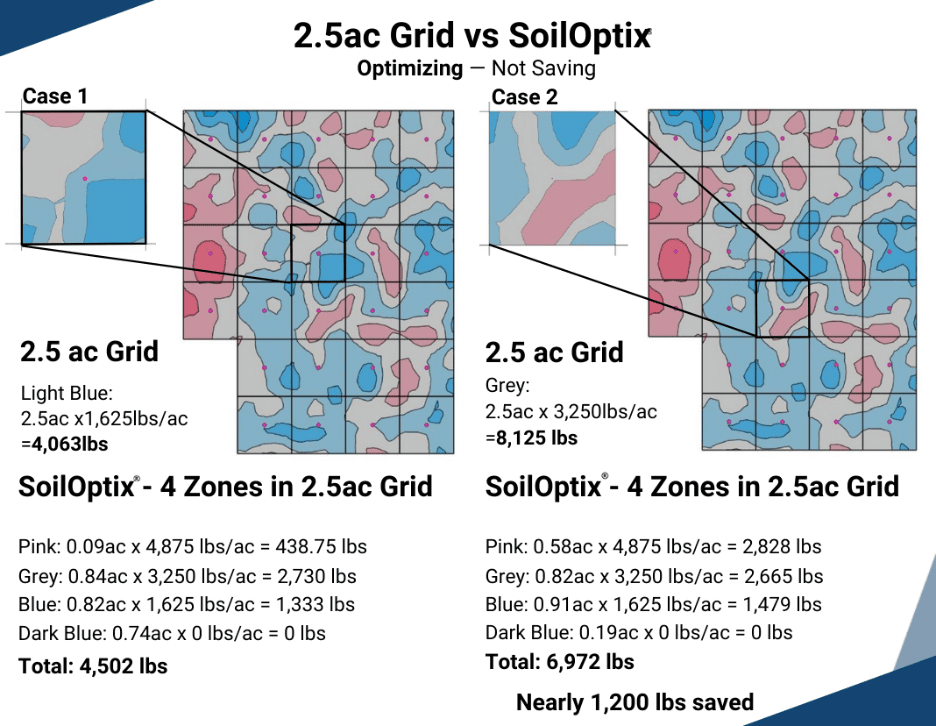
In the SoilOptix® case study, growers discovered that broad assumptions failed to reflect actual field variability. Once fertilizer variability mapping improved, prescription accuracy improved.
Research from the University of Minnesota Extension reinforces this point, noting that variable rate fertilizer application performs best when driven by accurate spatial data rather than generalized averages. The limitation is not variable in rate technology. It is data resolution.
High-Resolution Mapping vs Zone Sampling in Fertilizer Variability Mapping
The SoilOptix® case study, A Clear Advantage Over Zone Sampling, directly compared high-resolution soil mapping with traditional zone sampling.
The takeaway: when nutrient variability mapping improves, fertilizer prescription confidence improves. Nutrient allocation becomes more precise, strengthening soil data and its return on investment across the field.
This case study confirms that improved resolution directly supports stronger precision fertilization strategies.
Building Prescription Zones Using Fertilizer Variability Mapping
Prescription quality depends entirely on the quality of the underlying data.
The SoilOptix® case study, Prescription Zones for Variable Rate Applications, shows how high‑resolution SoilOptix® soil mapping enables growers to create precise prescription zones for variable rate applications, ensuring inputs are applied only where needed.
By combining detailed soil data with agronomic expertise, growers improve yields, reduce costs, and avoid blanket applications through more accurate, data-driven fertilization decisions.
When prescriptions are built using nutrient variability mapping rather than generalized assumptions, nutrient allocation becomes more accurate and defensible.
Many organizations, including The FAO, emphasize that sustainable soil management requires site-specific nutrient allocation. This case study demonstrates how precision fertilization strategies align with sustainable soil health goals while improving soil data ROI.
Optimizing Seeding Rates Within Precision Fertilization Strategies
Soil intelligence influences more than nutrient rates. It also shapes planting strategy.
In the SoilOptix® case study series on variable rate seeding using the Plant Available Water layer, growers used soil-derived moisture capacity data to adjust seeding rates across the field.
Part 1: Variable Rate Seeding Using Plant Available Water Layer
Part 2: Variable Rate Seeding Using Plant Available Water Layer
This case study showed that instead of applying uniform seeding, rates were aligned with soil moisture-holding potential. Higher-capacity zones supported increased seeding density, while lower-capacity areas were managed more conservatively.
The result… The average yield in the above case study was 231.65 bushels per acre, with the regional average at 190-210 bushels per acre.
Soil variability mapping supports smarter decisions across the entire production system, not just nutrient placement.
How Precision P & K Management Converts Field Variability Into Measurable Soil Data ROI
One of the clearest demonstrations of soil data ROI appears in phosphorus and potassium management.
In the SoilOptix® case study, ROI Through VRT Phosphorus and Potassium baseline fertilizer variability mapping revealed substantial nutrient differences across the field.
This case study followed three key stages:
Baseline Variability
Zones differed significantly in phosphorus and potassium levels.
Variable Rate Strategy
Instead of uniform fertilizer application, prescriptions were adjusted according to actual nutrient needs.
Measured Outcome
The case study reported reduced overapplication in sufficient zones and stronger nutrient investment where response potential was highest.
This real-world example illustrates how precision fertilization strategies convert variability into measurable soil data ROI.
Precision Fertilization in Calcareous Soils: How High‑Resolution Mapping Solves Mg–K Balance Challenges
Precision fertilization strategies become even more important in complex soil systems.
In this SoilOptix® case study, nutrient antagonism and cation balance challenges were addressed using high-resolution fertilizer variability mapping.
The case study revealed where magnesium levels influenced potassium uptake and where spatial correction was required. By implementing targeted variable rate applications, growers improved nutrient balance and strengthened long-term soil data ROI.
This case study reinforces that advanced soil chemistry management requires detailed fertilizer variability mapping to support successful precision fertilization strategies.
Modern Precision Fertilization Strategies Depend on High-Resolution Soil Data
Across these SoilOptix® case studies, consistent patterns emerge:
- Higher resolution enables stronger nutrient variability mapping.
- Refined zones improve variable rate performance.
- Precision fertilization strategies are dependent on the quality of the underlying data.
- Sustainable soil health depends on informed nutrient allocation.
These case studies demonstrate that high-resolution soil intelligence strengthens agronomic confidence, improves nutrient allocation efficiency, and supports long-term economic performance.
As agriculture continues to evolve, successful precision fertilization strategies will increasingly depend on measurable soil data and accurate nutrient variability mapping.
For growers evaluating variable rate technology, remember that better soil data leads to better decisions, stronger nutrient efficiency, and sustainable soil health.
If you are evaluating precision fertilization strategies or looking to improve soil data ROI across your operation, our team can help you explore how SoilOptix® fits within your current workflow.
Connect with us to learn how high-resolution soil intelligence can support better decisions in your fields!